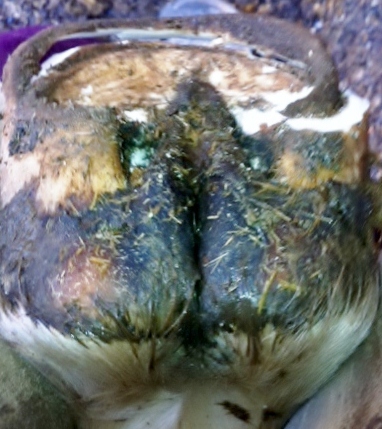
We tried just about everything to clear it up, but no treatment really seemed to promote healing of the infection or tissue regeneration. Things that worked on every other serious thrush infection I have seen didn't touch that one. I was beginning to wonder if we were ever going to beat it!
This photo was taken 2 years after the above photo. You can see the frog is definitely stronger, wider and healthier, but we couldn't get rid of that central infection! The pinkish color was due to one of the thrush medications that we were trying at the time.

In the past year we changed two main things, environment, and topical treatment. First, one of her turnout areas consisted of a hogfuel based footing. Hogfuel is, in my opinion, the worst footing available for horses in their turnout areas. It retains moisture, bacteria, and urine, is acidic, and is in a continuous state of decomposition so it is rotting material. It turns into nasty mud as it breaks down, horses often have allergic reactions to it which cause skin issues like mud fever and rain scald, as well as cause white line infections and frog rot. It is far too soft and moist to promote a healthy hoof and frog. This mare wasn't being kept on hogfuel,but one of her pastures was an old riding ring with broken down hogfuel, so access to that was removed. I think that was the first step to healing this infection. The hogfuel was no longer being pushed into the crevice which would have been continuously reintroducing bacteria and decomposing material to an already sensitive and weakened area.
Second was the use of a lovely little product called Special Formula 17900 Forte. It's actually a mastitis treatment for cattle, however it's a quadruple antibiotic, with hydrocortizone to help with inflammation. You can find all it's ingredients and info here:
http://www.drugs.com/vet/special-formula-17900-forte-suspension-can.html
In the US you guys have a similar products, although I can't find one that treats the same range of bacteria. Unfortunately here in Canada you can only get this product from a veterinarian, and some are very willing to sell it to you, others require a vet exam, which I think for this purpose is totally unnecessary, but to each their own. Also the price can range dramatically, you SHOULD be able to find it for under $10 a tube.
Here is what the miracle stuff looks like, as you can see it has a perfect fine little tip to it that lets you get it right into deep into the crevice! It does come out quick though so be careful, you don't need much!


This photo was taken 2 years after the above photo. You can see the frog is definitely stronger, wider and healthier, but we couldn't get rid of that central infection! The pinkish color was due to one of the thrush medications that we were trying at the time.
In the past year we changed two main things, environment, and topical treatment. First, one of her turnout areas consisted of a hogfuel based footing. Hogfuel is, in my opinion, the worst footing available for horses in their turnout areas. It retains moisture, bacteria, and urine, is acidic, and is in a continuous state of decomposition so it is rotting material. It turns into nasty mud as it breaks down, horses often have allergic reactions to it which cause skin issues like mud fever and rain scald, as well as cause white line infections and frog rot. It is far too soft and moist to promote a healthy hoof and frog. This mare wasn't being kept on hogfuel,but one of her pastures was an old riding ring with broken down hogfuel, so access to that was removed. I think that was the first step to healing this infection. The hogfuel was no longer being pushed into the crevice which would have been continuously reintroducing bacteria and decomposing material to an already sensitive and weakened area.
Second was the use of a lovely little product called Special Formula 17900 Forte. It's actually a mastitis treatment for cattle, however it's a quadruple antibiotic, with hydrocortizone to help with inflammation. You can find all it's ingredients and info here:
http://www.drugs.com/vet/special-formula-17900-forte-suspension-can.html
In the US you guys have a similar products, although I can't find one that treats the same range of bacteria. Unfortunately here in Canada you can only get this product from a veterinarian, and some are very willing to sell it to you, others require a vet exam, which I think for this purpose is totally unnecessary, but to each their own. Also the price can range dramatically, you SHOULD be able to find it for under $10 a tube.
Here is what the miracle stuff looks like, as you can see it has a perfect fine little tip to it that lets you get it right into deep into the crevice! It does come out quick though so be careful, you don't need much!
So.. what were the results? This photo was taken 2 months later
You can clearly see that the sulcus infection has finally met it's match. New tissue has almost completely filled in the central sulcus, and although her frog was going through a shed at the time of this photo it still had a healthy new frog underneath and on the road to a full recovery. Unfortunately we were heading into fall/winter and around here that means all sort of wet and sloppy conditions. We were a little worried that things might take a turn back to the dark side with the weather changes. So, how does that frog look now, 4 months later, in the middle of winter?
Great! I am so happy for this mare that we finally got rid of that nasty infection, and have a new treatment for the tool box. I have since tried it on a few sulcus infections and they were gone by the next trim cycle.
I have heard it's a good topical treatment for mud fever and rain scald too, talk to your vet if you think you might want to give it a try!